Qatar's climate puts window treatments through a stress test that most other countries simply don't. Temperatures that regularly push past 45°C, intense solar radiation for months at a stretch, and the kind of dust that finds every gap in a poorly fitted track. Buying curtains Qatar homeowners can actually rely on means thinking about these realities before choosing fabric, measuring a single centimetre, or clicking any checkout button.
Here are seven mistakes that come up again and again and what to do inste.
Most buying curtains Qatar problems come down to three things: choosing fabric without considering the heat and UV load, measuring the window instead of the full installation area, and skipping the lining. Add in ready-made sizing that doesn't fit Qatar's non-standard windows, no blackout and, a sheer layering plan, low-maintenance fabric that collects dust in every fold, and a track system that wasn't properly fitted, and you have the full picture. The sections below break each one down with enough detail to actually avoid them.
The curtain fabric for Qatar's climate is not the same as what works in London, Beirut, or even Dubai. Lightweight polyester that looks fine in a showroom photograph will sag, fade, and degrade within a single summer under direct western or southern exposure. Heavy velvet holds heat inside the room instead of blocking it at the glass.
Woven fabrics with a moderate weight, around 280 to 350 gsm, tend to handle the combination of UV intensity and air conditioning cycles better than the extremes. Natural cotton blends can work, but only when paired with a proper thermal lining.
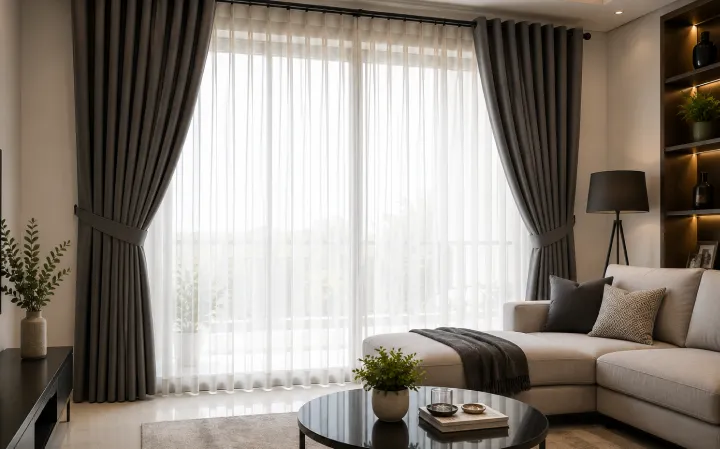
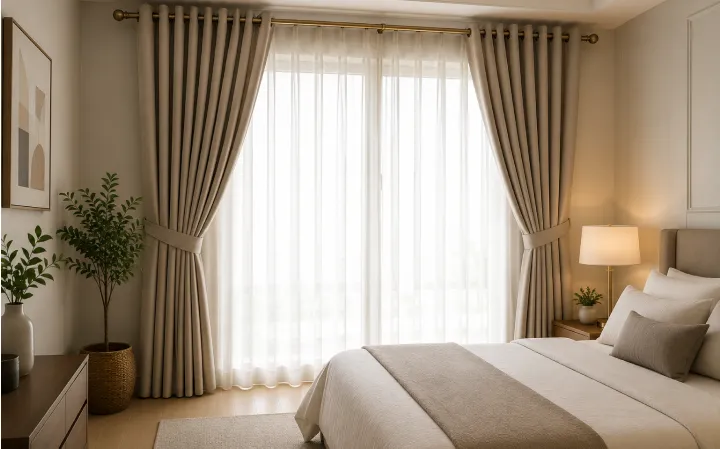
Blackout curtains in Doha are not just for bedrooms. Any room with western or southern-facing windows that catches afternoon sun needs a layered approach: a sheer for diffused daytime light and a blackout panel behind it for when the solar load becomes unbearable.
The problem most people run into is buying one or the other rather than planning for both. Sheers alone do almost nothing against Qatari afternoon sun. Blackout alone blocks the view and feels oppressive during the cooler months. The two together give you actual control.
This catches people more often than any other mistake. The window frame measurement and the curtain installation measurement are two different things. A floor-to-ceiling drop with a ceiling-mounted track rail system requires a completely different calculation than a wall-bracket installation above a standard frame.
Get the drop from your intended fixing point to the floor, decide whether you want the curtain to kiss the floor, pool slightly, or clear it by 1 to 2 cm, and measure the width with enough stacking clearance on both sides. Ready-to-measure curtains almost never account for this correctly.
Qatar's residential villas and newer apartment developments in Doha frequently feature windows and patio openings that fall outside standard sizing. Sliding glass doors that run 3 to 4 metres wide, unusually tall windows in majlis rooms, and bay configurations that follow the curve of an exterior wall.
Ready-made curtains in standard widths and drop lengths just don't work for these spaces. Made-to-measure curtains that Qatar homeowners in these properties actually need are cut to the exact installation dimensions.
A curtain without lining in Qatar is doing roughly half the job it could be. Blackout lining blocks light. Thermal lining adds an insulating layer that reduces the heat transfer through the glass and fabric, which has a practical effect on how hard the air conditioning has to work to maintain room temperature.
Curtain lining heat insulation is a functional specification, not a luxury add-on. Any curtain being installed on an exterior-facing window in Doha should at minimum have a blackout lining. For rooms that face direct sun during peak hours, a combined thermal-blackout lining is worth the additional cost.
Elaborate pleated fabrics with intricate textures look impressive in a display, but there is a chance to accumulate dust in every fold. Given Qatar's dust conditionsGiven Qatar's dust conditions, especially during shamal season when fine particulate matter settles across every surface, high-maintenance fabrics become a recurring cleaning problem.
A fabric that can be professionally dry-cleaned or machine-washed in panels is a more practical choice than one that requires specialist care every time. Ask specifically about the cleaning requirements before finalising any fabric.
The track or rail system carrying the curtains matters as much as the fabric itself. A ceiling-mounted curtain track rail system Qatar installers fit properly, distributes the weight evenly, allows smooth operation over time, and creates a cleaner visual line than a wall bracket rod. Poorly fitted brackets pull away from plasterboard walls, tracks bow in the middle under heavy fabric, and off-level fittings make curtains pool unevenly at the floor.
Professional measurement and installation removes these variables. The fitting itself directly affects how long the curtains function correctly and how they look day to day.
Getting curtains right in Qatar requires a different checklist than most other markets, because the climate, the window proportions, and the dust conditions are genuinely different. Fabric weight, lining specification, accurate measurement, and a properly installed track system all interact with each other.
If you're planning a curtain project in Doha and you're not sure where your measurement starts or which lining type suits your window exposure, talking to someone who works in this environment every day is worth doing before you buy anything. What's the one question you'd want answered before committing to a fabric or track system?
Mid-weight woven fabrics around 280 to 350 gsm tend to perform well because they balance UV resistance with breathability. Avoid very lightweight polyester on sun-facing windows and extremely heavy velvets in rooms with limited airflow. A thermal lining paired with a mid-weight face fabric covers most situations in Doha homes.
Tinted glass reduces glare but doesn't eliminate solar heat gain or block light during Qatar's intense summer afternoons. Blackout curtains add a separate barrier that operates independently of the glass spec. For bedrooms and western-facing living rooms in Doha, tinted glass and blackout panels together do a considerably better job than either one alone.
Start from the track or ceiling fixing point, not the glass edge. Measure the full drop to the floor, then decide on your hem clearance. For width, take the full track length and add at least 15 to 20 per cent per panel to allow for proper gathering. Large patio openings in Qatar usually require made-to-measure panels rather than anything off-the-shelf.
For most homes in Doha, yes. Ceiling-mounted curtain tracks handle heavier fabrics without bowing, give a cleaner finish, and operate more smoothly over time. Wall-mounted rods work for lighter sheer panels, but anything with a blackout lining or significant fabric weight generally needs a properly installed track system to hang and move correctly.
More often than in most other climates. During shamal season, fine sand and dust settle into fabric folds quickly. A rough guide for Doha homes would be a light shake-out or vacuuming every two to three months and a proper clean once or twice a year. Fabrics with a tighter weave and smooth face accumulate dust more slowly than textured or heavily pleated styles.
© 2026 - Aspire Furniture All rights reserved. Powered By SilverHost