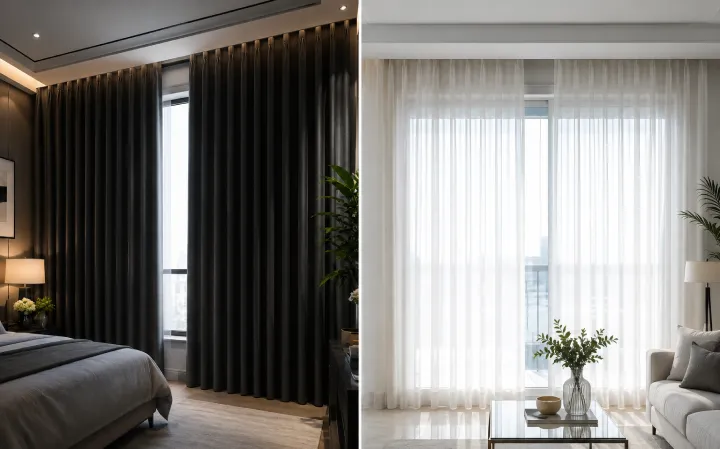
Qatar's sun does not follow a schedule. By early morning in July, direct light is already cutting through glass at an angle that turns a bedroom into something unusable. The debate between blackout vs sheer curtains is not just an interior design question here. It is a practical one, shaped by a climate that few other countries have to account for.
Both fabric types serve real purposes. Neither is universally better. The answer depends entirely on the room, the time of day, and what the window actually faces.
Blackout curtains are built around a single function: stopping light from entering a room. The fabric used is dense and opaque, sometimes woven with a tight multi-layer construction, and sometimes bonded to a blackout lining on the reverse. Either way, the result is the same. A properly made blackout curtain blocks up to 99.9% of visible light and eliminates UV rays entirely.
That UV elimination is where the thermal benefit comes from. When sunlight stops at the curtain layer rather than passing through to the floor and furniture, the room absorbs less heat. In Qatar's summers this directly affects how hard an air conditioning unit has to work. A bedroom with heavy blackout curtains often stays measurably cooler during peak afternoon hours than the same room with lighter fabric.
Bedrooms are the obvious starting point for blackout fabric. Shift workers, young children, and anyone trying to sleep through a bright Gulf morning will already know the difference. But the case for blackout fabric extends beyond the bedroom. A home office facing west gets unusable screen glare by afternoon. A TV room with an east-facing window cannot run daytime viewing without reflection washing out the display. In each situation, blackout lining solves the problem at the window rather than compensating for it elsewhere.
Sheer curtain fabric is a different category of product. It is not a dimmed-down version of blackout fabric. It does a completely separate job.
Sheers filter daylight. They soften the quality of the light entering a room without blocking it. A sheer-covered window in a living room still lets in enough brightness to read by without the direct glare of unfiltered sun. They also maintain outward visibility in daylight conditions, which changes how a room feels. A lounge with full blackout treatment at midday can feel closed off. The same room with a quality sheer fabric reads as airy and open.
Privacy works differently with sheers than most people expect. During daylight hours, the brightness outside is higher than inside, which means the fabric reflects outward and prevents visibility into the room. After dark this reverses. Interior light makes the sheer translucent from the outside. Anyone installing sheers for privacy reasons in a ground-floor room should think about how the window reads at night.
For Qatar homes, sheers work best in living spaces, dining areas, and any room where the goal is atmosphere rather than light control. They handle diffused morning light in east-facing rooms well. In rooms without direct sun exposure, they often need no blackout layer at all.
The most common solution for window treatment Doha installers are asked to do is a double-track setup. One curtain rail carries a sheer panel close to the glass. A second track, set slightly in front, carries a heavier blackout or blackout-lined curtain. During the day the blackout panel sits open at the side. At night, or when full light blocking is needed, it draws across.
The problem most people run into is buying one or the other rather than planning for both. Sheers alone do almost nothing against Qatari afternoon sun. Blackout alone blocks the view and feels oppressive during the cooler months. The two together give you actual control.
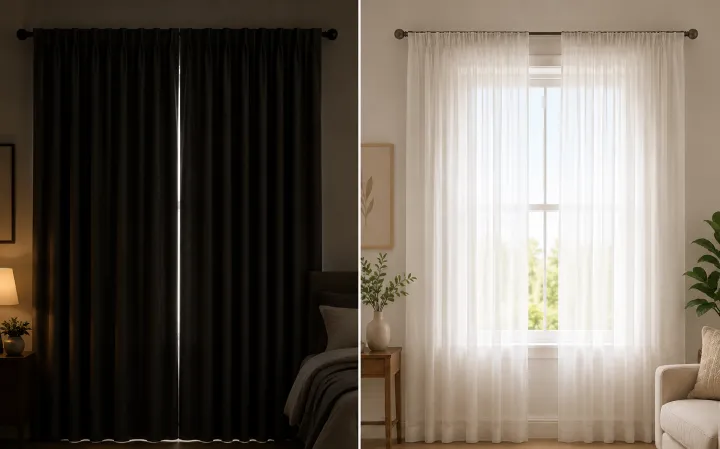
A bedroom facing any direction benefits from blackout fabric. There is no argument for a bedroom sheer on its own in Qatar. The sun is too direct, and the heat gain is too real to accept anything less than full light blocking for a sleeping space.
A living room usually works better with sheers, either alone or paired with a blackout panel on a double track. The goal in a living space is a balance between privacy and openness, not total darkness.
A home office depends on screen orientation relative to windows. If the monitor faces a window, anti-glare or blackout treatment is necessary. If the desk sits parallel to the window, a sheer may be enough.
Kitchen and bathroom windows generally work well with either a sheer or a light-filtering roller blind, since direct light is less of an issue and ventilation often takes priority over fabric weight.
The blackout vs sheer curtains question does not have a single correct answer, but it does have a clear framework. Match the fabric to the function the room needs, not to a general preference for light or dark. Most Qatar homes end up with both types installed across different rooms, and many benefit from a double-track setup that avoids the need to choose. If the priority is sleep quality , UV protection, or heat reduction, blackout fabric is the right call. If the priority is a well-lit, comfortable daytime living space, sheers handle it better than any blackout fabric can.
For bedrooms, genuinely yes. The sun in Qatar is intense enough that even a slightly thin curtain lets in enough light to disrupt sleep, especially in summer. Full blackout fabric also reduces heat coming through the glass, which takes some of the load off air conditioning. For living rooms the answer is more nuanced.
During daylight hours, yes, they do. The light outside is brighter than inside, so the fabric reflects outward, and people cannot easily see in. After dark this flips. Interior lighting makes the sheer much more transparent from the street side. Ground-floor rooms with sheers need a heavier curtain layer for evening privacy.
Yes, and it is probably the most practical setup for a Qatar home. A double curtain track puts a sheer layer close to the glass and a blackout panel in front of it. You get full light control at night or during naps and an airy, filtered feel during the day. The two layers operate independently.
Sheer fabric usually makes the most sense for a main living space. A living room benefits from diffused natural light during the day, and a sheer panel delivers that while keeping the room from feeling dark or closed in. If the room has a window with direct afternoon sun, a double track with a blackout panel behind the sheer gives you the option to block it when needed.
The fabric itself makes the biggest difference. A blackout curtain with dense weave construction or a bonded blackout lining acts as a barrier between the hot glass and the room interior. It absorbs and deflects heat before it enters. Paired with a close-fitting curtain track that minimizes the gap at the sides and top, a well-installed blackout curtain can noticeably reduce the heat load on a room.
© 2026 - Aspire Furniture All rights reserved. Powered By SilverHost